2023 forecast for the Danish and Swedish life sciences sector

Three things to take away
- What is the outlook for the Danish and Swedish life sciences sector and how could limited diversification impact growth prospects
- What are the three future risk areas life science firms should be aware of in 2023
- What can life science firms do to boost growth using scalable production, digitalization and recruitment.
The Nordic countries’ life sciences sector employs 39,000 people in Denmark (1.4% of the total workforce) and 27,000 in Sweden (0.5% of the total workforce). The sector is concentrated in a small number of larger companies.
The short-term outlook is strong. However, this is largely driven by sales of a single new drug, rather than a broader expansion of the sector. This creates uncertainty about longer-term prospects. Meanwhile, regulations, particularly at the European level, present a significant burden for companies, threatening to undermine the profitability of smaller players.
Introduction
The Nordic countries’ life sciences sector employs 39,000 people in Denmark (1.4% of the total workforce) and 27,000 in Sweden (0.5% of the total workforce). Most of the sector’s activity takes place in “Medicon Valley”, an area which spans eastern Denmark and southern Sweden1.
Relative to the EU, the Nordics’ life sciences sector is concentrated in pharmaceuticals. Whilst the EU’s pharmaceutical sector makes up 0.9% of the total EU economy, Denmark’s pharmaceutical sector makes up 2.9% of its economy. The sector is concentrated in a small number of larger companies. Novo Nordisk, a Danish pharmaceutical company, has a large presence in the region. It employs around 18,000 people in Denmark, more than two-thirds of the people who work in Denmark’s pharmaceutical sector2. Sweden’s life sciences sector is also relatively concentrated in pharmaceuticals, making up 84% of the Swedish life sciences sector and 1.2% of its economy.
The short-term outlook for the sector is strong. However, this is largely driven by sales of a single new drug, rather than a broader expansion of the sector. This creates uncertainty about the longer-term prospects for the region. Meanwhile, regulations, particularly at the European level, present a significant burden for companies, threatening to undermine the profitability of smaller players.
1. https://mva.org/wp-content/uploads/2022/05/20220518_Life_science_easter_denmark.pdf
2. https://mva.org/wp-content/uploads/2022/05/20220518_Life_science_easter_denmark.pdf
Economic contribution of the life sciences sector

The Nordic countries’ life sciences sector contributes a total of €18 billion to the Swedish and Danish economy. Compared to life sciences sectors across European Union countries, the Swedish and Danish life sciences sector makes up amongst the largest proportions of each economy’s GDP.
Whilst life sciences make up 1.2% of total EU member states GDP, the sector makes up 3.5% (€11 billion) of Denmark’s GDP and 1.4% (€7 billion) of Sweden’s GDP.
The Swedish and Danish life sciences sector makes up amongst the largest proportions of each economy's GDP
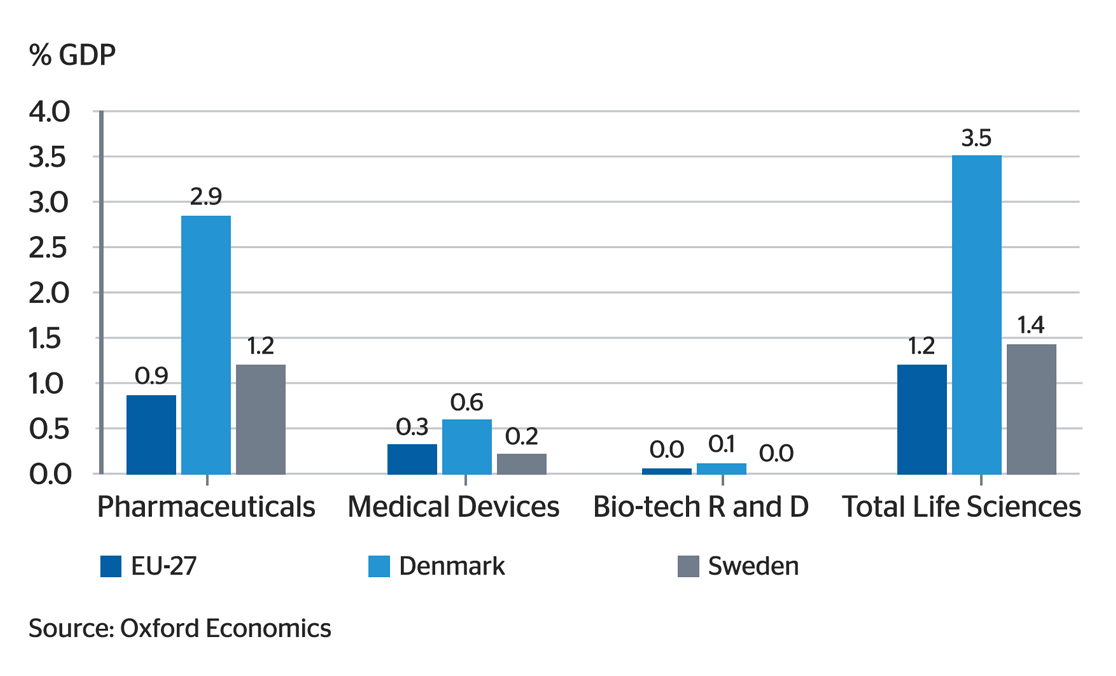
3. Eurostat data 2020. NACE codes 21,266,325,7211. Data availability means 2019 data is used for the EU-27
Future growth prospects for the life sciences sector
The life sciences sector has promising long-run growth trends—increased purchasing power in developing economies; ageing populations; and increased interest in health in developed ones—means demand is expected to be strong. Rising global obesity rates (which are strongly related to diabetes) will be a growth area for Denmark in particular, as half of the world’s insulin is produced at Novo Nordisk’s plant in Kalundborg, Denmark. One market research firm predicts that the global insulin market is expected to grow at a compound annual growth rate (CAGR) of 5.9% from 2023 to 20304.
Focusing on the dominant pharmaceutical sector, the Nordic sector experienced strong growth between 2010 and 2019, with annual growth of 7.4%. This is double that of the German pharmaceutical sector in the same time period (which is the largest pharmaceuticals producer in the EU).
4. https://www.linkedin.com/pulse/insulin-market-predicted-surge-ahead-impressive-cagr-59-dhole

Looking forward, we expect strong growth in the Nordic pharmaceutical sector in 2023. This is largely due to Novo Nordisk’s strong sales in the diabetes and anti-obesity medication Semaglutide, sold under the brand names Ozempic, Wegovy, and Rybelsus. This contributed to Danish pharmaceutical gross value added (GVA) being 66% higher in Q1 of 2023 than in Q1 of 2022. Output of Semaglutide is expected to be particularly elevated in 2023 as availability of the medications were constricted for much of 2022 due to high demand and supply chain issues limiting supply5.
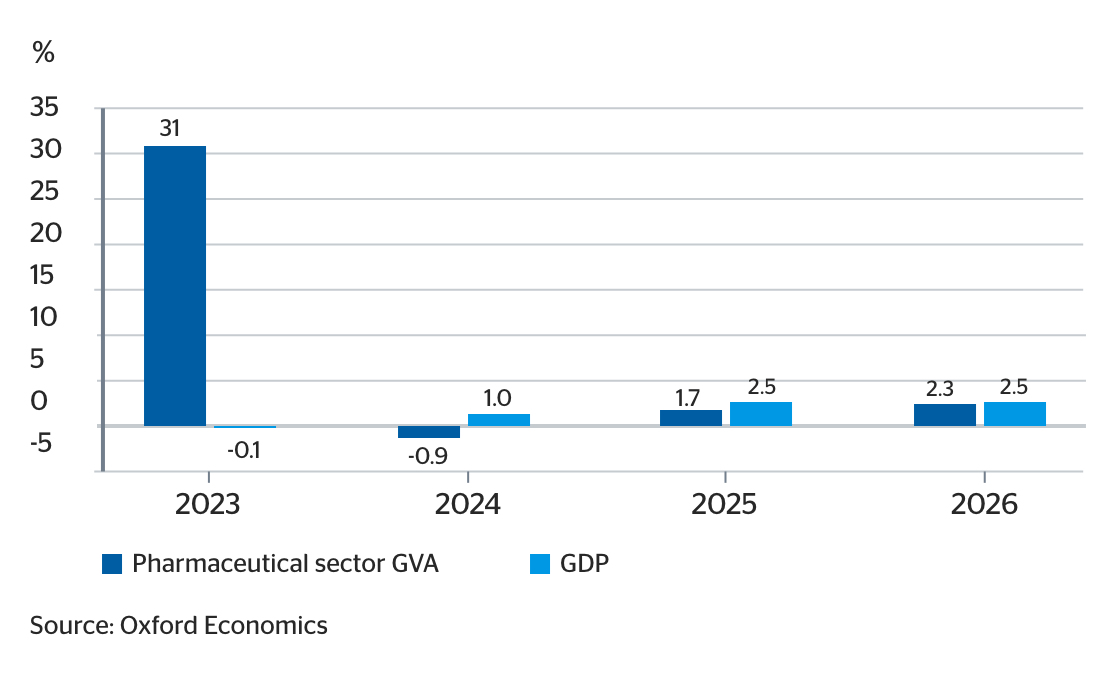
The recent uptick in growth means our forecasts suggest that the Nordic pharmaceutical sector will expand by 31% in 2023. Given the large forecast jump in output we expect growth to contract slightly in 2024 (by 0.9%). We then expect output to return to growth in 2025 and 2026, (1.7% and 2.3% respectively).
However, given that one company makes up a large part of the Nordic pharmaceutical market, we caution that there is likely to be a significant degree of uncertainty in these forecasts. Future sales in Semaglutide will depend on other competitor drugs, future regulation, consumer sentiment, and the degree to which production can be scaled up.
Forecasts suggest the Nordic pharmaceutical sector will expand by 31% in 2023

Future risks to watch
- The potential impact of a lack of diversification could hurt growth. With a life sciences sector concentrated in a small number of firms and growth focused on small number of products, there is greater exposure to declines in demand for specific products than in regions with greater diversity. In particular, the outlook for diet drugs if initial demand fades or competitors come onto the market would be reduced growth.
- The EU in April proposed a significant overhaul of its flagship pharmaceutical regulations, intending to deal with affordability and availability, but potential improvements will likely require several years to materialise. Nonetheless, the proposal will likely drive costs in the industry, for instance by conditioning market exclusivity with availability of drugs across all 27 EU member states. Parts of the proposal where political pressure is the strongest, such as measures against drug shortages, will likely see some of the strongest measures, and could materialise before the reforms pass. Companies selling drugs listed as “critical medicines” will therefore likely be subject to higher regulatory scrutiny.
- Meanwhile, will national governments take steps to alleviate the regulatory burden on businesses in the sector? The Danish government has not indicated major plans and the Swedish government has pushed changes at EU level. Their likely response to the EU proposals will become clearer in the coming months.
What can life science firms do to boost growth
In times of high demand, businesses need to be able to scale up production quickly. Outsourcing parts of the production process can help businesses handle short-term surges in demand. Spreading supply across production sites may also be beneficial; in the case of Novo Nordisk, shortages of Semagludtide arose due to regulators finding issues with manufacturing practices in a contractor manufacturer’s Belgian site6. Although a lower dependence on this site would have minimised the shortage, having multiple manufacturers can also bring problems. These include decreased negotiating power and economies of scale as well as challenges with quality control.
Life science companies in the region report that recruitment of skilled employees is increasingly difficult7. In 2022, the Danish government published a list of professions, for which it is looking for foreign workers to come to fill vacancies8. The list includes several professions in the field of life sciences. There is a risk that continued skills shortages will obstruct growth in the sector. Building stronger links with educational institutions could help to increase skill levels. Businesses could also work closely with universities to help ensure that the educational content is relevant for working in the industry.
There is a risk that continued skills shortages will obstruct growth in the sector.
Providing more opportunities for internships during educational training as well as offering traineeships where graduates can shift between companies could also help to increase knowledge and skills.
Life science firms should look to leverage many of the productivity boosting changes Covid-19 brought about. Shifting from in-person to decentralised trials enabled by tools such as telemedicine and wearable medical devices has reduced patient burden and reporting subjectivity9. Decentralised trials can boost productivity by reducing costs and clinical trial timelines and improving patient recruitment and retention.
6. i) https://www.novonordisk.com/content/nncorp/global/en/news-and-media/news-and-ir-materials/news-details.html?id=92023 ii) https://www.pharmaceutical-technology.com/comment/novo-nordisks-wegovy-supply-challenges/#:~:text=However%2C%20challenges%20remain%20in%20the,issues%20with%20good%20manufacturing%20practices
7. https://mva.org/wp-content/uploads/2022/05/20220518_Life_science_easter_denmark.pdf
9. https://www2.deloitte.com/content/dam/Deloitte/br/Documents/life-sciences-health-care/deloitte-life-sciences-outlook-2022.pdf